
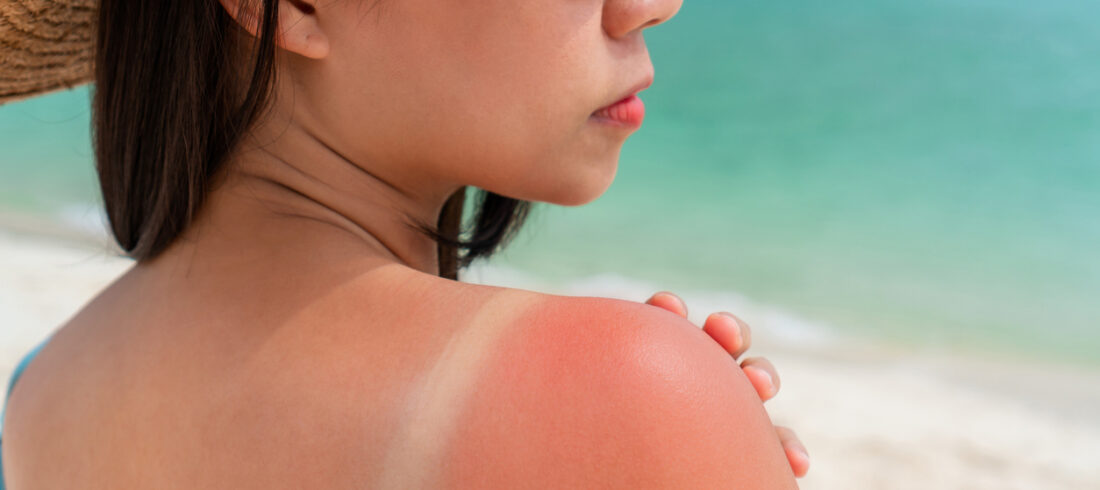
Many of us know we should put on sunscreen when outside in the summer. But despite our best efforts, we sometimes forget the sunblock and end up with a bad sunburn and skin damage. How do you know if it will heal on its own, or if it’s time to see the doctor?
Experts say if you get a small patch of first-degree sunburn, which is the least severe type, you can most often treat it at home. In these cases, your skin turns red, might feel hot to the touch, and become quite sensitive. It’s uncomfortable, yet there are many things you can do to alleviate the soreness and support healing:
- Cool the skin with damp cloths
- Enjoy a lukewarm bath
- Apply aloe vera or moisturizing lotion
- Take ibuprofen or acetaminophen for pain
- Drink lots of water
- Avoid further sun exposure
But if first-degree burns cover more than 15% of your body, you develop blisters, or start to feel sick, you have a more severe form of sunburn and it’s important to get medical attention.
Think of it like this: Sunburn occurs when you’re exposed to too much ultraviolet (UV) light. With minor sunburn, the top layers of the skin are harmed. But with severe sunburn, the damage reaches the deeper layers of your skin and can become systemic – causing an inflammatory response inside your body. The blisters you develop are prone to infection, and the chemicals produced by inflammation pull fluid away from the rest of your body, causing dehydration. Many people with severe sunburn will experience fever, chills, headache, nausea, muscle aches, and may feel faint. If this occurs, it’s important to seek medical help right away. Your doctor can administer medications that will help facilitate the healing process.*
Know your sunburn risk
Unfortunately, some people are more prone to sunburn than others. If you fall into any of these categories below, you’re at a greater risk of burn, and it’s important to take extra precautions when outside:
- Are fair skinned, have blue or green eyes, have blonde or red hair
- Take non-steroidal anti-inflammatory drugs such as aspirin or naproxen
- Take birth control pills, tetracyclines, water pills, or are on chemotherapy or hydroquinone
- Use skin care products such as retinol, glycolic acid, salicylic acid, and benzoyl peroxide
It’s always important to check the label of any medication you take or any product you put on your skin to understand if it puts you at a higher risk of sunburn. Even if you’ve used the product before without any issues, it’s a good rule of thumb to double check to be extra sure, as formulas can change over time.**
You can still have fun in the sun
The fear of sunburn doesn’t mean you can’t enjoy time outside in these wonderful summer months. You know the saying: an ounce of prevention is worth a pound of cure. By following these simple rules, you can look great and stay safe:
- Seek out the shade as much as you can
- Wear loose clothing that covers your arms and your legs
- Choose a hat with a wide brim to shade your face, head, ears, and neck
- Purchase sunglasses that wrap around and block both UVA and UVB rays
- Use a broad-spectrum sunscreen with a sun protection factor (SPF) of 15 or higher
It’s also a good idea to read the label on your sunscreen bottle to know how much of the lotion to use and how often to reapply. The key to staying safe is applying sunscreen generously and often.***
7 surprising facts to know about sunburn
Can pets get sunburn?
Yes. Pets with thin, light-colored, or sparse fur are at the most risk for sunburn. But all pets can get burned on areas where the fur is thin, such as the nose, ears, belly, and around the eyes and mouth.
Will I see a sunburn right away?
This is surprising to a lot of people, and it’s important to know. Sunburn doesn’t usually appear until 2-6 hours after UV exposure. So don’t wait until you feel the burn to get out of the sun.
Why is Aloe Vera good for sunburn?
Aloe vera is 98% water, making it an excellent natural moisturizer that hydrates your skin without leaving it greasy. It also contains special compounds that help soothe burns and abrasions.
Can I get a sunburn on a cloudy day?
This is another surprising fact. While UV rays are strongest on a cloudless day, they can still penetrate cloud cover and reach your skin. And remember that many surfaces such as grass, sand, and seafoam reflect the sun’s rays.
Can I get sunburn while under water?
Even if you’re totally submerged under water, you can get a sunburn. In some cases, water can even increase your exposure.
Why does my skin peel after a sunburn?
The body is amazing in how it heals itself. When the outer layers of your skin are damaged beyond repair, our cells actually activate a built-in self-destruct program called apoptosis. Rather than leaving damaged cells in place, our body removes them and replaces them with healthy new cells.
What is sun poisoning?
Sun poisoning is a term used to describe a severe sunburn. It can have symptoms such as blistering or peeling skin, severe rash and/or pain, swelling, headache, fever and chills, nausea, and dizziness. These symptoms are the result of heavy damage to the skin and dehydration as a result of the burn drawing fluid away from the rest of your body.
Summer sunburn doesn’t mean we can’t fully enjoy everything this wonderful season in the Hudson Valley has to offer. We just need to take some precautions. Call our dermatology team at (845) 451-7272 any time to discuss how to stay safe this summer and be sure to make an appointment if you’re experiencing a severe burn.
*[https://www.cdc.gov/skin-cancer/prevention/sunburn.html]
**[https://www.cdc.gov/skin-cancer/prevention/sunburn.html]
***[https://www.cdc.gov/skin-cancer/prevention/sunburn.html]